
The Nominee Company Shortcut Is Being Actively Unwound
For years, some foreign buyers used a Thai limited company, with Thai shareholders in name only, to hold land and a house on it. It was never actually legal unless those Thai shareholders had a genuine stake. But enforcement used to be inconsistent enough that plenty of buyers treated it as a workable shortcut.
That’s changed in 2026. If you’re planning to buy a house in Pattaya, it’s worth understanding exactly what’s happening before you consider any structure involving a Thai company.
What’s Actually Happening in 2026
Thailand’s Department of Business Development introduced Order No. 2/2568, effective January 1, 2026, requiring Thai shareholders in a company with under 50% foreign ownership, or with a foreign director holding signing authority, to submit three months of bank statements at incorporation. The goal is to verify that share capital actually came from the Thai shareholder’s own funds, not from the foreign party behind them. A related order, No. 1/2569, now requires companies to certify they aren’t using nominee arrangements. These order numbers and requirements are reported consistently across multiple legal advisories, including One Asia Lawyers, and press coverage of the crackdown independently confirms that firms classified as at-risk have had to submit additional financial documents before registration since January 1, 2026. It’s still worth confirming the exact current wording with a licensed Thai lawyer before relying on the specifics for your situation.
On the enforcement side, Bangkok Post has reported more than 17,500 cases referred to the Department of Lands for ownership review, an AI screening system running since October 2025, and a joint operation in Chon Buri province, where Pattaya sits, that led to arrests and searches across 41 locations. A multi-agency operation in Pattaya in March 2026, involving the DBD, tourism authorities, and the Chon Buri Provincial Commerce Office, flagged 146 foreign entities in the province for further investigation. One case involved a single Thai national holding shares in more than 100 companies with a combined investment value of at least 300 million baht, exactly the kind of nominee pattern the new verification rules are designed to catch. Nationwide, this tightened scrutiny reportedly contributed to a roughly 60% drop in new at-risk company registrations in the first quarter of 2026 compared to the same period the year before.
The consequence for a confirmed nominee arrangement is set out in Land Code Section 94: a disposal order, giving the landowner between 180 days and one year to sell the property, with proceeds going to the seller. This is not a proposed penalty. It’s the existing legal consequence, now being applied more consistently than before.
Why This Was Never Actually a Safe Shortcut
It’s worth being precise here: a Thai company holding land has always been legal, provided the Thai shareholders are genuine, meaning they actually invest and share in the company as the law requires. What’s changed isn’t the underlying rule. It’s how seriously it’s being checked, and how much data-sharing across agencies now makes an arrangement that used to fly under the radar much harder to keep quiet.
If you’re currently in a company structure that wouldn’t hold up to genuine scrutiny of who actually funded it, that’s a conversation to have with a licensed Thai lawyer now, not something to wait out. Siamglow works closely with one of Pattaya’s more established law firms, and we’re happy to answer questions and help point you toward what actually applies to your situation, whether you’re buying for the first time or reviewing something you already own.
What This Means If You’re Buying an Existing House, Not Building New
Most of this so far applies whether you’re buying a plot to build on or a completed resale house. But resale buyers have one extra thing to check: how the current owner holds the land.
If the property you’re looking at is currently held through a Thai company, ask directly whether that company would hold up under the verification now in place. A disposal order under Land Code Section 94 attaches to the land itself, not just the current owner, so buying into a structure that’s already under scrutiny, or likely to attract it, can leave you dealing with someone else’s compliance problem. This is exactly the kind of thing a lawyer should check before you pay a deposit, not something to take on the seller’s word.
The Route That Actually Works: Registered Leasehold
For most foreign buyers wanting a house rather than a condo, a registered leasehold on the land is the straightforward, legal path. You lease the land for up to 30 years, the maximum under Section 540 of the Civil and Commercial Code, and you own the house itself, the physical structure, in your own name, provided you’re the one who applied for the construction permit.
Any lease longer than three years must be registered at the Land Department, under Section 538 of the Civil and Commercial Code, or it only holds legal force for three years regardless of what the contract says, so registration isn’t optional paperwork, it’s what makes the lease actually enforceable long-term. Registration costs 1.1% of the total rental value across the lease term: 1% as the registration fee plus 0.1% in stamp duty. The lease gets noted directly on the back of the land’s title deed.
Be careful with renewal promises. Some contracts advertise consecutive 30-year renewals, sometimes marketed as “30+30+30.” In 2025, Thailand’s Supreme Court ruled that pre-agreed renewal terms of this kind are void: a lease beyond the initial 30 years needs a genuinely new agreement made at the time of renewal, not a right locked in upfront (confirm the case reference and how it applies to your specific contract with a licensed Thai lawyer, since case law interpretation can evolve). Ask a lawyer to explain exactly what a “90-year lease” listing actually guarantees before you rely on it.
Reading the Title Deed: The Garuda Color System
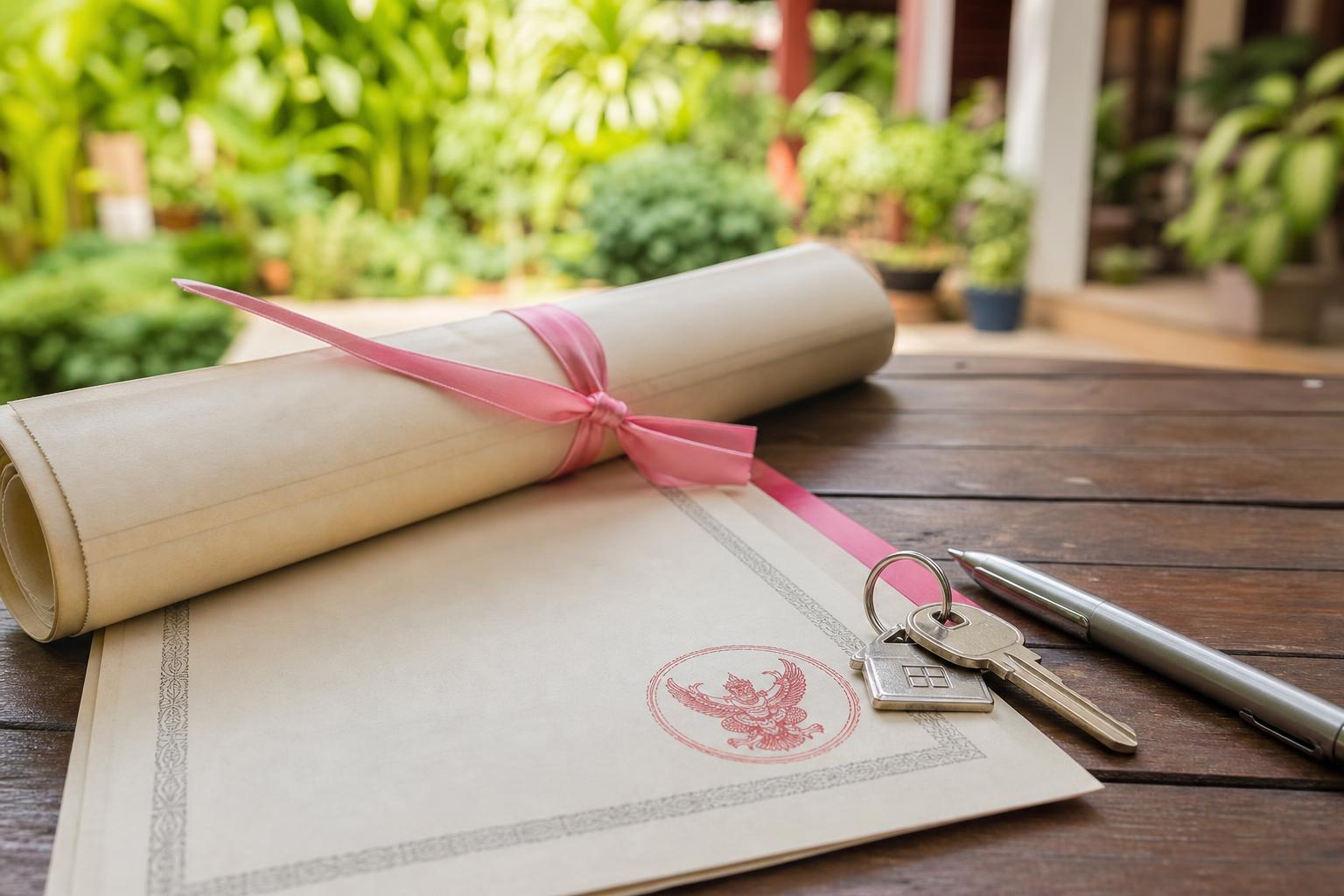
Before you commit to any land, whether under a lease or otherwise, check what kind of title deed it actually has. Thailand marks land documents with a Garuda emblem in different colors, and the color tells you how strong the title really is.
- Red Garuda — Chanote (Nor Sor 4 Jor): full, surveyed freehold title. This is the only title type that gives complete, unambiguous ownership rights, and it’s what you want the land under any house you’re leasing to have.
- Green Garuda — Nor Sor 3 Gor: a confirmed right of possession, with a certified survey, but not full title. Common and generally reliable, though a step below Chanote.
- Black Garuda — Nor Sor 3 / Nor Sor 3 Khor: possession rights without precise, surveyed boundaries. Boundary disputes are more likely with this type.
- Blue Garuda — Sor Kor 1: an old occupancy claim document. It does not confer ownership at all, and land with only this document has a much weaker legal foundation than any of the above.
If a listing or a seller can’t tell you which of these applies, or is vague about it, treat that as a reason to bring in a lawyer before going any further, not after.
A Practical Path Forward
- Rule out any structure built around a Thai company unless you’re genuinely prepared to have real, invested Thai shareholders, verified with real documentation.
- For a house, plan around a registered leasehold on land with a Chanote (red Garuda) title, with the lease properly registered at the Land Department, not just signed privately.
- Have an independent lawyer review the specific renewal clause in any lease before you sign, given the 2025 Supreme Court ruling on pre-agreed renewals.
- Ask directly what title type the land carries, and don’t treat a vague or reassuring answer as confirmation.
- If you already hold land through an older company structure, get it reviewed now rather than waiting to see if enforcement reaches you.
Our guide on common mistakes to avoid when buying in Pattaya covers related red flags, and our step-by-step buying guide walks through the wider purchase process. You can browse current houses and pool villas currently on the market.
Frequently Asked Questions
Is it too late to fix an existing nominee company structure?
Not necessarily, but it needs attention now rather than later. Options depend on how the structure was originally set up and what documentation exists, so this isn’t something to assess on your own. Siamglow works closely with an established Pattaya law firm and can help answer initial questions and point you in the right direction.
Is a registered leasehold actually secure?
Once registered at the Land Department, a lease is a recognized legal right for its term. Renewal beyond 30 years requires a new agreement made at the time, not a pre-agreed right, following a 2025 Supreme Court ruling. Review your specific contract’s renewal clause with a lawyer.
Can I just buy the house without worrying about the land under it?
No. In Thailand, land and buildings are legally separate. Owning a house without a clear, legal arrangement for the land beneath it leaves your position on that land undefined. Always confirm both pieces before you pay anything.
This article is general information, not legal advice. Land and company structures in Thailand carry real legal and financial consequences if set up incorrectly. Always confirm your specific situation with a licensed Thai lawyer before signing anything or restructuring an existing arrangement.
Buying a house in Pattaya and want to make sure you’re doing it the right way, or reviewing a structure you already have? Talk to our team. We work closely with an established Pattaya law firm and can help answer your questions.