
The Videos Are Real. The Conclusion People Draw Is Usually Wrong
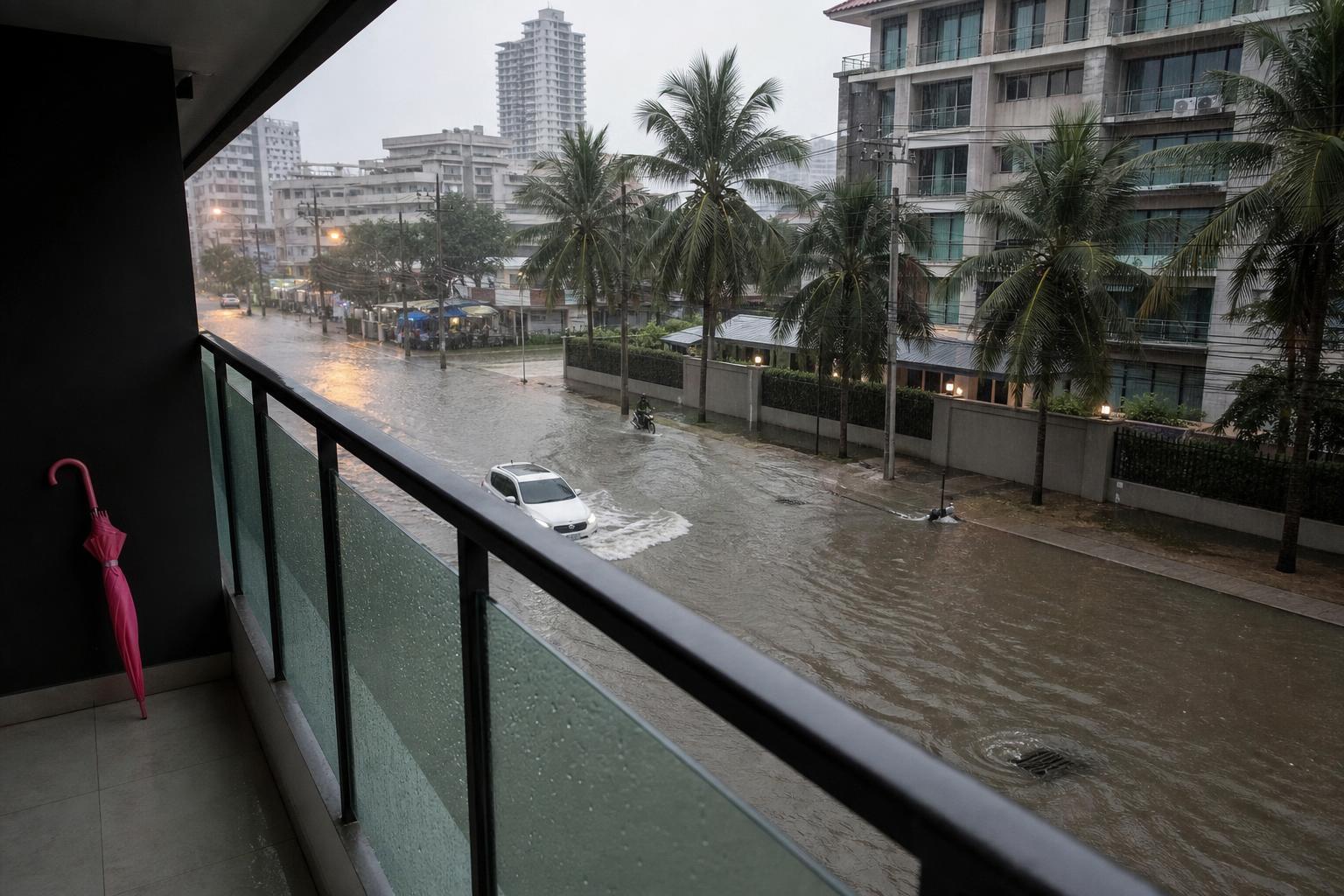
Every rainy season, the same clips circulate: motorbikes pushing through brown water on Sukhumvit Road, cars stalled near South Pattaya junction. It happened again on the night of 10 September 2026. Rain started around 10:30 pm and ran for more than an hour, and several main routes went under water.
If you’re looking at property here, that footage raises a fair question: is this a city with a flooding problem, and does it affect what you’re about to buy? The honest answer has three parts. Yes, parts of Pattaya flood, and real damage happens. No, it does not affect every area or every building equally. And yes, there is a funded plan to fix it, though not overnight. Here’s what a buyer actually needs to know.
What Happened This September
On 10 September, heavy rain hit from about 10:30 pm. The Pattaya News reported flooding on Soi Khao Noi, Khao Talo Road, the road running alongside the railway, and stretches of Sukhumvit Road in both South Pattaya and central Pattaya. Khaosod English reported water at roughly 10 to 60 centimetres on several roads. City officials blocked off the deepest sections with metal barriers to keep vehicles out.
Be clear about the damage, because this is where property listings tend to go quiet. Local reporting on this year’s events describes vehicles disabled after water reached their engines, and damage to homes and businesses at ground level. Road water usually drains within hours once the rain stops, but “usually” is not “always”, and a ground-floor property sitting level with the road has no margin when it doesn’t.
That said, the risk profile is specific. For most buyers looking at a unit on an upper floor, the exposure is about access, parking and the building’s ground level, not about the apartment itself.
Why It Happens
Pattaya sits between higher ground to the east and the sea to the west. When a storm drops a large volume of rain in a short time, that water moves downhill across the city toward the beach. The drainage network has to carry it through a built-up area that has grown considerably faster than its underground pipes.
This is why the same locations appear year after year. It is a capacity problem at specific choke points, not random bad luck.
The city’s own monitoring reflects that: its sensor network tracks water moving from the eastern areas, through the centre, and out to the sea. For a buyer, the takeaway is that a property’s position along that path matters more than the district name on the listing.
Which Areas Are More Exposed
In May 2026, Pattaya Mail listed Jomtien, Huai Yai, Nongprue, Naklua and Wongamat among the areas where officials watch for temporary flooding during heavy rain. The broader risk categories are consistent across reports: major traffic routes, beachside roads, underpasses, and densely built neighbourhoods where drainage was designed for a smaller city. We have not found a single published municipal list of affected streets, so treat area names as indicative, not as a definitive map.
That does not make these areas bad places to own property. Jomtien remains one of the busiest markets in the city, and on most storm nights only parts of it are affected. What it means is that within these areas, the difference between one soi and the next can be significant, and that difference is worth checking before you sign.
The single biggest factor is elevation. Pratumnak is the main central area with genuine elevation, and higher ground drains faster by simple physics. Parts of East Pattaya also sit higher. Much of the rest of the city is close to flat, so on flat ground the deciding factors become the age and capacity of the local drainage, and how the specific plot sits relative to the road.
What the City Is Actually Building
This is the part that rarely makes it into the viral videos, and it changes how you should read the risk over a ten-year holding period.
According to Pattaya Mail’s April 2026 reporting, city executives briefed the Prime Minister on a flood management master plan valued at 26 billion baht, covering 226.47 square kilometres and more than 144,000 households across three drainage basins: the central Pattaya urban zone, the Naklua sub-basin and the Huai Yai sub-basin. Phase 1 was scaled from an initial 5.3 billion baht to 2.75 billion baht for the urgent works, planned across a four-year budget cycle from 2027 to 2030, with Pattaya City funding 10%. The same reporting notes that, because the investment exceeds one billion baht, the plan needs Cabinet approval before full implementation.
Something smaller is already under way. The Pattaya News reported in May 2026 that the city’s Sanitation Bureau, working with the Chonburi Provincial Administration Organisation, was installing a smart water management system: 43 sensors inside drainage pipes and 15 road surface sensors in Phase 1, with roughly 50 more pipe sensors planned for Phase 2. It is built to measure water levels and flow rates in real time and to feed alerts to drainage and rescue teams. Phase 1 was scheduled to be operational by the end of July 2026, but we have not found an official confirmation that the full network is live, so treat it as in progress.
Sensors do not stop water. They change response time, and they produce the data needed to design and justify bigger pipes. The honest horizon for physical improvement is the 2027 to 2030 works, not this rainy season.
If You’re Buying a Condo
For a unit well above the ground floor, the flood risk to the unit itself is very low. The exposure sits elsewhere, and these are the things worth checking:
- Parking. Basement and ground-level parking is the most common point of real financial damage. Ask whether the garage has ever taken water, and how the building responded.
- Access. A building can stay completely dry while the only road to it sits under half a metre of water. Look at the soi, not just the lobby.
- Lifts and electrics. Ground-level lift pits and electrical rooms are where a short flood turns into a long outage.
- Ground-floor commercial units. If you’re buying one of these as an investment, flood exposure is a direct income question, not a comfort question.
The practical move is simple: ask the juristic person directly how the building performed during the last heavy storm. They will know, and their answer, including how quickly they give it, tells you something about how the building is managed.
If you can, visit during rainy season. Between roughly May and October you have a reasonable chance of seeing a real storm, and one visit in bad weather tells you more than any listing description. Most buyers view in high season, when everything is dry and the photos look their best. That is the single easiest gap to close in your own research.
If You’re Buying a House
One point before the water: if you’re buying as a foreigner, the ownership structure is a separate question from flooding, and a more important one. A foreigner can own a condo unit outright within a building’s 49% foreign quota, but cannot hold land in their own name, so a house normally involves a registered lease on the land or another structure. Our step-by-step guide to buying property in Pattaya as a foreigner covers that side, and it’s worth having a lawyer confirm the structure for your specific purchase.
On flooding itself, houses carry more exposure, because everything you own sits at ground level. When you look at houses in Pattaya, the checks are different:
- How high does the plot sit relative to the road? A house built level with the soi has no margin at all.
- Where does water go when it leaves the property? Look for the drainage in the soi itself, not only inside the wall.
- In a gated development, who maintains the internal drainage, and is it actually maintained? Private drainage is an advantage only if someone is looking after it.
- Ask neighbours. People who have lived through three rainy seasons on that street will tell you plainly, and they have no reason to sell you anything.
Insurance: Check Before You Assume
In most Thai condominiums, coverage is split. The juristic person usually holds a master policy over the common property and the building structure, typically up to the original internal surfaces of your unit, while the owner insures what’s inside: contents, renovations and improvements. The exact split is set by the building’s own regulations and by what the owners’ meeting has voted, so it varies from one building to the next.
Flood is where assumptions get expensive. Depending on the policy, flood cover can carry its own limit, its own exclusions, or exist only as an optional add-on. Ask the juristic person for the policy summary, and have a licensed broker or your lawyer confirm in writing what is and is not covered before you rely on it. For a house, you carry the full structure yourself, so the question matters more.
Frequently Asked Questions
Does flooding affect property values in Pattaya?
Not in a way we see at city-wide level. From the transactions we handle, price movements here track supply, foreign demand and location quality far more than rainfall. At street level it can matter, because a soi with a known flooding problem is harder to resell and harder to rent than a comparable one two streets away. Treat it as one factor in location quality, not as a separate market force.
Which Pattaya areas are least affected by flooding?
Elevation is the main differentiator, and Pratumnak is the main central area with real elevation. Parts of East Pattaya also sit higher. Beyond that, the useful comparison is not between districts but between individual streets, since drainage capacity varies within the same neighbourhood.
Is the flooding problem being fixed?
There is a plan with numbers attached. Pattaya Mail reported that city executives briefed the Prime Minister in April 2026 on a 26 billion baht master plan, with a first phase of 2.75 billion baht scheduled across 2027 to 2030, still subject to Cabinet approval. A sensor-based monitoring system is being rolled out, though we have not seen official confirmation that it is fully operational. Realistically, expect improvement over the coming years rather than in the next rainy season.
If you’re weighing up a specific building or a particular soi and want a straight answer about how it handles heavy rain, get in touch with our team. We’re here through every rainy season, and we’d rather tell you what we’ve actually seen than let you judge a building from a listing photo taken in January.